18 Oct 2015

Navaratri 2015: Day 5 - Skanda Mata

“Once you sit in the Divine Mother’s lap, it doesn’t matter ‘who is who’ or ‘what is what’. Everything is Her. At that moment, you really realise Her grandness as Shakti and Parashakti, and how She infuses Herself in everything and still remains Herself.” – Sri Swami Vishwananda


Devi Name: Skanda Mata

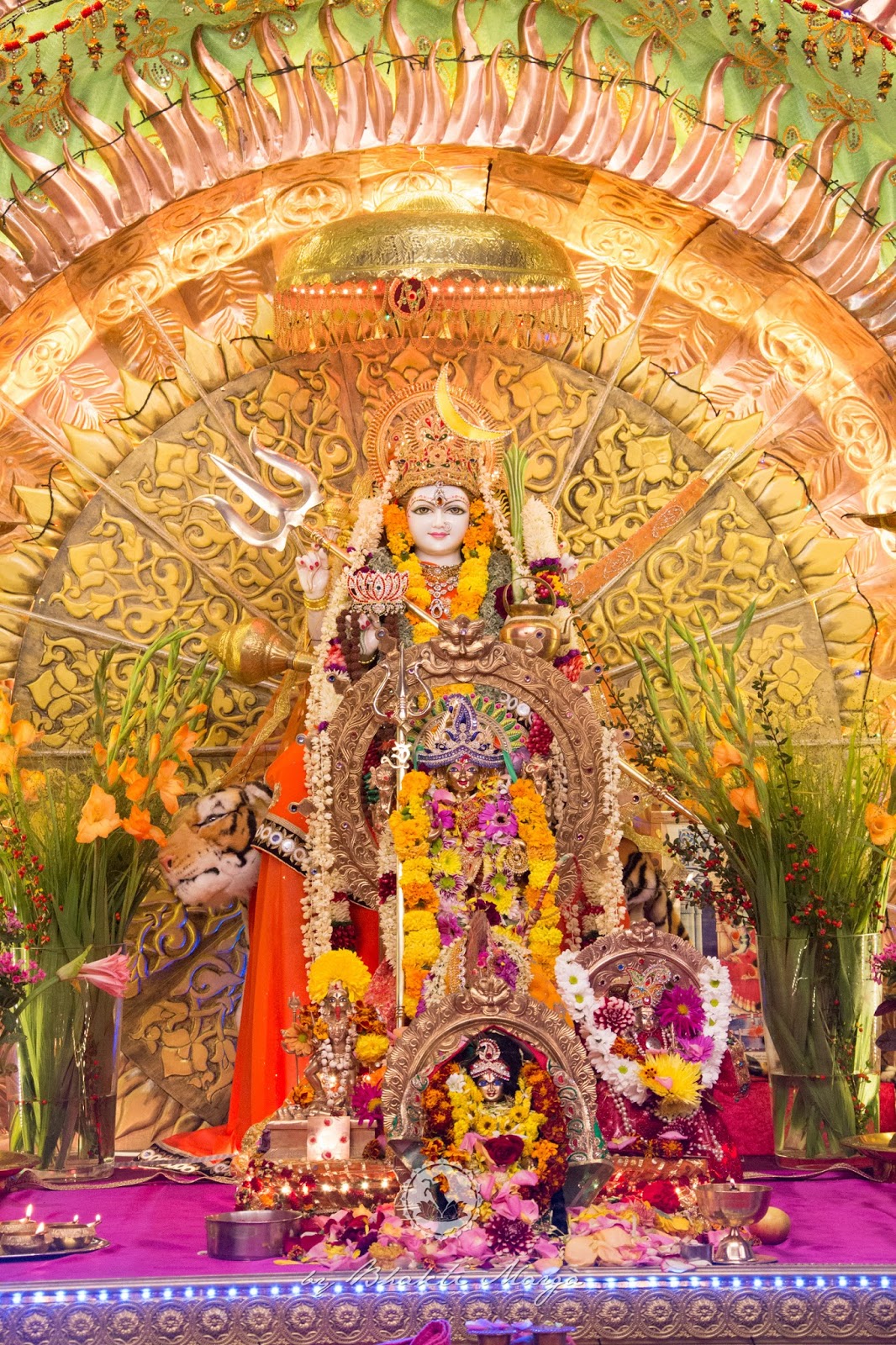
Skanda Mata means ‘the mother of Skanda’. ‘Skanda’ is a name for Kartikeya, or Muruga, who is the son of Shiva, while ‘Mata’ means ‘mother’. She has four arms and is seen holding Skanda with one arm in Her lap. The upper two arms are holding lotus flowers, while the fourth arm is displaying the Abhaya mudra. The Abhaya mudra represents fearlessness, and is used to bestow blessings such as protection, peace, and courage. By worshipping Skanda Mata, one also receives the blessing from Kartikeya, who is the commander of the celestial armies.


By having Skanda on Her lap, the Devi is showing that She is the Mother of all power and of all forces. She gives the power to vanquish negativity. Holding Skanda, She shows that the Divine Mother always holds onto Her children, whether they are conscious of it or not.


Event Highlights:


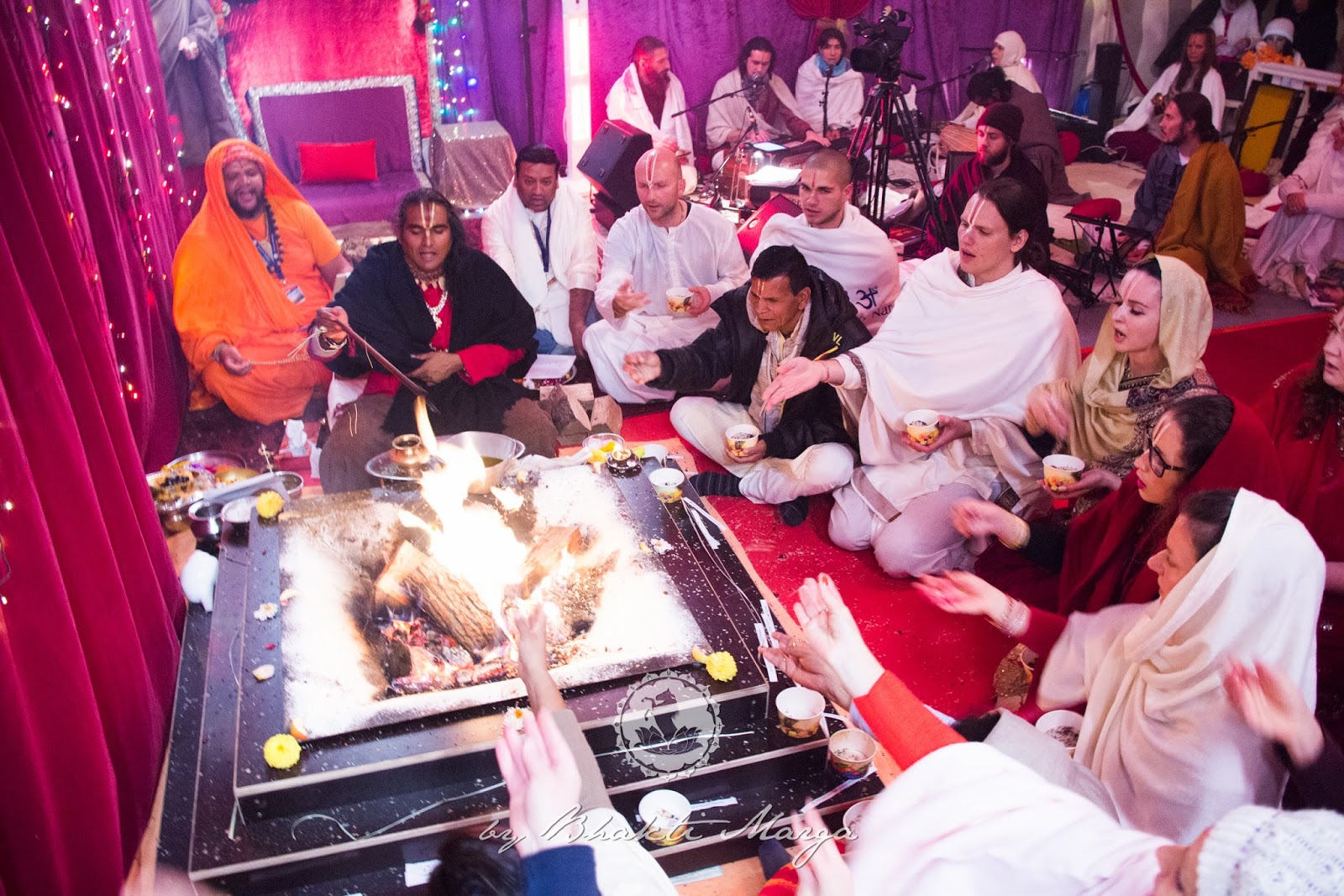
The fifth night of Navaratri was characterized by the enthusiasm of all who participated. Because it was a Saturday night, more devotees were able to come and be part of the ceremonies and festivities in the Tent and in the Light Hall. The night included Guru Puja, Devi Puja, yagna and more. After the yagna, Sri Swami Vishwananda graciously walked through the main pathway, and distributed blessed water to everybody.


Later in the evening, Sri Swami Vishwananda sang a number of joyful bhajans that lifted the energy of the devotees singing along. The bhajans legitimately rocked last night! Even walking through the Light Hall inside Shree Peetha Nilaya, you could hear people singing and clapping with the livestream footage. The night ended with a party of Dandiya dancing (stick dancing). People were dancing from the back of the tent to the front – an exhilarating night!


Towards the end of the night, Sri Swami Vishwananda also gave a short talk about Skanda Mata. He said:

Today we celebrate the fifth Day of Navaratri, dedicated to Skanda Mata. The baby that she holds represents not only Skanda, but all humanity. She is Jagad Janani. 'Janani' means 'sweet mother'. Here Maha Bhagavati took this form to remind us that everyone is Her child and all are Her creation.

Without Shakti nothing works. Without energy inside of you, there is nothing that you can do. Even if the great yogis don't acknowledge the Shakti inside of them, they become useless. In the Durga Chalisa, there is one verse that says that Sri Adi Shankaracharya didn't acknowledge Divine Mother. So, the Mother had to remind him to crush that pride, because very often when pride and ego arises, one becomes blind. However, when you are in complete darkness, you look for the light, you long for the light. Then, you realise how important this light is. When you are in the light, you take it for granted and don't realise the importance of it. The same thing with the life which God has given you. You don't realise how important it is. Then, just before you leave the Earth, you realise, “My goodness, life is very important!”

If you are in tune with the Divine, the Divine will guide you to your dharma. You don't need to do anything. You don't need to know anything. You are guided continuously to that dharma. Sometimes, something terrible may happen to bring you to that dharma. Sometimes, Grace may bring you to that dharma, but there is this universal Shakti which controls everything, and that's Maha Bhagavati. Her aim is to help you to advance to the Feet of Narayana, to the ultimate Realisation. That's why each of the chakras of your etheric body is governed by one form of Divine Mother, one form of Shakti. And when you rise higher up, you have the Sahasrara Chakra, the thousand-petaled lotus, which is upside down. This is the Grace of the Lord which He is pouring upon you every day. However, when you transcend, when you have crossed over these seven lotuses, then you have an open lotus towards someone who is higher. It's Maha Bhagavati's work to bring you so that you can rise and so that you can sit on that lotus. Once you have attained that higher lotus, the Grace ever flows through you.

In the whole world, everybody is like a little child and Skanda Mata is reminding us all, “Look I am carrying all of you, but you have to give yourself. If you don't give yourself, how would I carry you?” Like that, Bhagavati reminds us that She holds everybody. God has brought you on the spiritual path – it's not your will to be on this path, but it is your dharma. This Grace is not given to everyone. Often, I remind you that this world has seven billion people. Out of these seven billion, how many people turn out to be spiritual? There are lots of religious people, but very few spiritual people.

The bhakti – the devotion that you have for God, the devotion that you have for the Divine inside of you – that's your power, that's your Shakti. Whenever you surrender to the Divine, then She will carry you. You don't need to bother about anything. That's what the Guru does. He carries you and brings you to your Divine Self, reminding you continuously that your dharma is to Love. Not superficial love, but ultimate Love, and that's your true aspect. - Sri Swami Vishwananda 


For more impressions from the event, please check out our Facebook page:

https://www.facebook.com/SriSwamiVishwananda

17 Oct 2015

Navaratri 2015: Day 4 - Kushmanda Devi

“Kushmanda manifested Herself at the moment creation happened. She removes all sorrows and diseases and gives life strength, peace, fame and joy.” – Sri Swami Vishwananda


Devi Name: Kushmanda Devi

Kushmanda Devi is the creator of the universe. Before the universe came into existence, it’s said that there was a dark void, but with just a smile, Kushmanda Devi manifested the whole Cosmos. Unlike the other Devis who either existed before or after the creation of the universe, Kushmanda Devi was manifested right at the moment of creation. It is through Her power that everything was created.


In Sanskrit, ‘Kushmandam,’ means ‘pumpkin.’ Thus, in the worship of Kushmanda Devi, it’s essential to offer pumpkins throughout the ceremony. Kushmanda Devi also has eight arms. Seven of Her hands hold the holy kamandalu, a bow, an arrow, a lotus, a pot containing wine, a disc and a club. The eighth hand holds a japa mala which reminds us of the power of our sadhana (our spiritual practice).

Event Highlights:


On the fourth night of Navaratri, the ceremonies continued and the love for the Divine Mother only grew more and more. The event included a classical Indian dance, a short satsang from Sri Swami Vishwananda, storytelling, and much more. It began with the Guru Stotram and Guru Puja, followed by the customary Gauri Ganesh Puja and a yagna dedicated to the Divine Mother.


During the yagna, Sri Swami Vishwananda arrived and greeted all those attending as he entered into the event tent. After some time of assisting behind the curtains, Swamiji concluded the yagna and offered the final prayers. Once the yagna ended, Sri Swami Vishwananda conveyed the importance of Kushmanda Devi, the fourth form of Nava Durga:

Today is the fourth day of Navaratri dedicated to Goddess Kushmanda. In the word Kushmanda, 'Kush' means 'happy' and 'manda' means the same as 'ananda' or 'supreme happiness'. So, Maha Bhagavati in the form of Kushmanda bestows the supreme happiness. What is this supreme happiness? Often we say that we are happy, but very quickly this happiness changes to unhappiness. You are happy in one moment, but in the next moment your mood swings to the other side, and you become unhappy. How many times a day does this happen? Observe yourself from morning till evening, and see how many times your mood has shifted, from happiness to unhappiness.

True happiness is only when people find their path; like you have found your path, you are truly happy. When one finds one's Guru, one is happy. When one finds the true purpose of life, the true dharma, then one becomes happy. The rest comes and goes, but true happiness stays forever. True happiness gives you inner satisfaction, not only outer satisfaction. Outer satisfaction lasts for a very short time, but inner satisfaction lasts forever.

True happiness is when you find Bhagavan inside of you and you build a relationship with Him. This relationship is not from now, but it is a continuation. He has a long-term relationship with you, not a short-term. Even death can't destroy this relationship. This relationship carries on, life after life, because He wants to embrace you. He wants you to be near to Him, dear to Him! So, this relationship that your Atma has with Paramatma is unique. This is the true relationship. All the other relationships come and go. – Sri Swami Vishwananda


For more impressions from the event, please check out our Facebook page:

https://www.facebook.com/SriSwamiVishwananda

16 Oct 2015

Navaratri 2015: Day 3 - Chandraghanta Devi

“Chandraghanta spreads calmness and eternal peace all around Her, but to someone who is wicked, She is terrifying. If your mind is negative, all things around you will be negative. But if your mind is clear, pure and calm, all around you will be calm.” – Sri Swami Vishwananda


Devi Name: Chandraghanta Devi

Chandraghanta Devi (sometimes spelled Chandrakanta) is the form of Maa that grants eternal strength to Her devotee. As ‘Chandra’ is the name for the moon, She is named Chandraghanta because of the bell-shaped mark of a crescent moon on Her head. This form of Maa possesses ten arms holding many weapons and She sits on top of a lion.


Because of Her incredible beauty, the demon king, Mahishasur, wanted to have Her as his wife, to which the Divine Mother replied, “If you want to be My husband, you have to be stronger than Me.” Mahishasur had forgotten that the Divine Mother is the one who enacts everything, and that it would be impossible for him to defeat Her. Furious, he sent thousands of demons towards Chandraghanta Devi, but with one pronunciation of the syllable, ‘sa’, Devi instantly turned all the demons to ash. (Such is Her power and grace to destroy the spiritual demons within all of us.)


After an intense battle, Chandraghanta Devi killed the demon king, and received the alternative epithet of Mahishasur Mardini, ‘the destroyer of the demon Mahishasur.’

Event Highlights:

The celebrations for Chandraghanta Devi felt more like a family gathering, rather than a public event. The third night had the underlying theme of “Vasudhaiva Kutumbakam” – the whole world as one family. According to the structure of these ceremonies, the night included the puja, yagna, Devi Mahatmya narration, and as always, a lot of singing and dancing! Though once the final prayers had finished and all had received their blessing and darshan from Chandraghanta Devi, the amrit of the night was yet to emerge.


As the night came to an end, Sri Swami Vishwananda asked that each Swami and Swamini give a small improvised speech. The newly-appointed Swami’s/Swamini’s expressed their gratitude to Sri Swami Vishwananda, and some shared their personal surprise that Swamiji wanted to initiate them into Swamihood at all! It was said several times that they were grateful to have a Satguru who has all the qualities of the mother and who can be a most affectionate one, and yet, still discipline when the need arises. It was the love and experiences that the Swami’s and Swamini’s shared for Sri Swami Vishwananda that united all who attended -- even the distant family watching via livestream.


The sincerity of each speech showed that they weren’t talking to a crowd of strangers, but rather to a family of devotees. At times, the tent was roaring with laughter, and at other times, it was silent with rapport. After all of the Swami’s/Swamini’s had given their talk, Sri Swami Vishwananda ended the night with a few words of wisdom that gave insight into the role of the Swami’s and Swamini’s and about the importance of respecting others:

(The) Swamis are my representatives, of Mahavatar Babaji, of (the) Sri Sampradaya - Sri Ramanuja Acharya - in their respective countries. Devotees have to respect them but, even before that, they should give the respect; we can't expect to be respected or loved without giving the respect, and loving others.
All the Masters and all the holy scriptures say that one should not have expectations, “Don't let your left hand know what your right hand is doing.” When there are no expectations, you are free, and what flows through you is only the Grace and the Love, only the blessing, and this is not only for Swamis, but for all on the path towards God Consciousness, on the path towards Narayan.

Keep reminding yourself to be humble. Like Krishna in the Bhagavad Gita reminded Arjuna of his duty, the Guru reminds the devotees also of their duty in life, because life is a learning process. It's very rare to receive the Grace to be under the guidance of a Satguru, so you have to follow and transform yourself. When you give your effort, whatever the Master blesses, it will become active, it will be manifested.


For nine days, throughout the night you are singing, dancing, thinking of Maa – (it’s a) good technique to change the mind, otherwise the mind will run outside. During these nine nights, Maa cleanses you and removes all the negative aspects that you have accumulated, under the guidance of the Master. You have taken a path that is purifying you and that is making you shine. (The) Swami(ni)s have taken the path of service, so (they) have to be more humble than anybody; (they) should never expect people to respect them, but they should always give respect. – Sri Swami Vishwananda
For more impressions from the event, please check out our Facebook page: https://www.facebook.com/SriSwamiVishwananda

15 Oct 2015

Navaratri 2015: Day 2 - Brahmacharini Devi & Swami Initiations

“Brahmacharini Devi reminds us that, in reality, life is very simple. If you take all the glamorous parts of your life, you will see that a person doesn't really need much to be happy, especially if you are on the spiritual path.” – Sri Swami Vishwananda


Devi Name: Brahmacharini

Brahmacharini Devi is the Goddess that represents the importance of sadhana. In this form of Durga, She performed an intense penance to obtain Lord Shiva as Her husband. Her right hand holds a japa mala to remind us of our spiritual practices and to chant the Divine Names. Her left hand holds a kamandalu (water pot), which symbolises Her life-giving Shakti.


Brahmacharini Devi's penance that lasted 600 years. She spent the first 300 years surviving only on the leaves that fell from the forest trees. For the next 300 years, She didn’t even take food or water. Despite the efforts of Her family, and even Lord Shiva in disguise who tried to disrupt Her penance, She persevered and attained what She so longed for – Shiva Bhagavan.


Event Highlights:


The second night of Navaratri began with the initiation of eight Swami’s and two Swamini’s. Everyone watched as one by one, each Swami and Swamini received their final blessings before officially ending the inauguration into Swamihood. In front, each Swami/Swamini also received a danda (staff), a tulsi necklace, and garland of fresh flowers from Sri Swami Vishwananda.


The names of the Swami’s and Swamini’s are listed below with their previous name shown first, as well as the country that each one is responsible for:

Appointed Swami

Rishi Nikhilananda – Swami VishwaRevatikaantananda

Country Swamis

PORTUGAL: Satavarta – Swami VishwaNarashardulananda
RUSSIA: Shankarsha – Swami VishwaJanaardananda
RUSSIA: Kayaker – Swami VishwaIndushekarananda
CZECH REPUBLIC / SLOVAKIA: Raghudas – Swami VishwaBaladharananda
GERMANY: Rishi Madhavananda – Swami VishwaMadhavananda
CROATIA / SLOVENIA / SERBIA: Chatur – Swami VishwaKanjalochanananda
SPAIN: Ashirvani – Swamini VishwaPrabhaavati Mata
ROMANIA & FRANCE: Ananda – Swamini VishwaGodaavari Mata

INITIATED IN 2008 FOR THE FIRST TIME- Ananta- VishwaDhaanamJayananda


After the initiation, Sri Swami Vishwananda spoke about what it means to be a Swami, and the importance of humility on the spiritual path. Here is an excerpt:

To be a Swami is not something easy. Whether you are a Swami, a brahmachari or a devotee, on the bhakti path one must be humble. To attain the Grace of the Divine, in any situation, one must be humble. This is very important. For Love to awake, it's not just to say, “Oh, I am a brahmacharini” or “I am a Swami”, or “I am this” or “I am that”. As a human being you should love and respect everybody, and above all, as a Swami, you should set a better example than anybody else. That's why Mahavatar Babaji has chosen you, because He saw certain qualities inside of you. Now, you are not aware of these qualities, but that will come. This is your dharma! 


When you take a certain path in life, that path becomes your dharma. Dharma is not about going around saying, “My dharma is only to become a healer” or to become this and that. Each one has his or her own dharma. A dharma of a Grihastha is to look after the family. What is the use of a Grihastha, if he or she is doing other things instead of looking after his or her family? If you have taken a path in life, you have to honour that path. The path of a brahmachari is to concentrate on God. It doesn't mean that anyone is superior. 


Don't think that when one becomes a Swami, a brahmachari, or a devotee, they are superior. No, there is no superior. In God's eyes everybody is equal. How much you shine your light, that much light He will shine back to you. However, His Love, His blessing is equal.

So, that's what I ask of you: be humble! Help people. Love everybody. When you have to be strict, be strict! But it doesn't mean that you should not respect others. So, with the blessing of Mahavatar Babaji, Sri Ramanuja Acharya and all the saints, spread the Love of God! – Sri Swami Vishwananda

Even though the initiations were undeniably the highlight of the night, it’s astonishing to remember that all of this took place before the worship of Brahmacharini Devi began. The rest of the night included a yagna, bhajans, Devi Mahatmya narration, and much more. And still, after of all the glorifications and final prayers were finished, the excitement had yet to reach its climax and the Dandiya (stick) dancing broke out. The night was, yet again, amazing in every way possible.


The second night of Navaratri is one that will be remembered for a very long time, as each initiated Swami and Swamini is assigned to uphold a specific dharma. In time, each will grow into their respective positions and work hard to spread the message of Sri Swami Vishwananda. Last night was not only the beginning of Swamihood for these ten devotees, but it was also a historic night for the future of Sri Swami Vishwananda’s mission. Just as God never gives a blessing for the sake of one person, so too is the case with Sri Swami Vishwananda.


The blessing that Swamiji gave last night to each Swami and Swamini is one that will not be kept for themselves, but is a blessing that will be shared with the whole world; it is a blessing that will empower the Swami’s and Swamini’s to carry on the life purpose of Sri Swami Vishwananda: to open the hearts of man.

For more impressions from the event, please check out our Facebook page: https://www.facebook.com/SriSwamiVishwananda

14 Oct 2015

Navaratri 2015: Day 1 - Shailaputri

“Shailaputri represents the blessing of the Guru, 'sadhana-bhakti', as She is the One that gives the Shakti, the power to activate one's sadhana to start the inner journey. This blessing is very important because it destroys the pride and ego.” – Sri Swami Vishwananda


Devi Name: Shailaputri

The first night of Navaratri is dedicated to the Goddess Shailaputri. ‘Shaila’ is a name for the Himalaya Mountains, and ‘Putri’ means daughter, so She is the daughter of King Himavan, the Lord of the Mountains. In Her previous incarnation, She was Sati, the daughter of King Daksha who immolated Herself because of Her father’s disrespect for Lord Shiva, Sati’s husband.


Shailaputri sits mounted on an ox and holds a trident in Her right hand with a lotus flower in Her left. Often times She is referred to as the most powerful and most glorified of all the forms of Durga. Shailaputri is also the Goddess of the muladhara chakra, or base chakra.


Event Highlights:


The beginning of Navaratri started at the Kali temple, where devotees gathered to circumambulate Shree Peetha Nilaya. The front of the procession carried the different deities of Divine Mother, while the back marched on despite the downpour of rain. Upon entering the tent, the deities were installed in their proper place on the altar and all the people entered and bundled up with their blankets.


Sri Swami Vishwananda was already in the tent before the procession arrived, making arrangements for the ceremonies to come. Once everybody was seated and all the preparations were in order, Swamiji gave a short talk and led a guided meditation. His speech introduced the importance of Navaratri and emphasised that one should use these nine nights to feel the Divine Mother’s Love and be transported to the abode of Narayana. As Swamiji guided the meditation, everybody closed their eyes and fixed their awareness within their hearts. Swamiji explained that, before seeing Her (the Divine Mother) outside, we have to recognise Her inside.


The ceremonies themselves began with Guru Puja. It’s important to remember why we always do Guru Puja first, as it’s only through the grace of our Guru that we may obtain the grace of the Divine Mother and the Grace of God. After Guru Puja, the customary rituals were performed that included the Kalash of the Nine Goddesses, where we invoke each Goddess into a kalash, as well as Bhairava Puja. Bhairava Puja is essential to the worship of Maa because of the blessing of Vaishnava Devi to the demon Bhairava.


All in all, between the spirited bhajans from the music team, the chanting of the Devi Sahasranam, and the vibrant decorations that supported the celebration, the night ended with Sri Swami Vishwananda and devotees alike, dancing and jumping out of love for the Divine Mother. The first night of Navaratri was one that felt complete in every way, and makes one wonder how much more is still to come, as this was only the beginning…


For more impressions from the event, please check out our Facebook page: https://www.facebook.com/SriSwamiVishwananda

13 Oct 2015

Navaratri 2015 - Pitra Paksh


On 12 October 2015 at Shree Peetha Nilaya (SPN), we performed Pitra Paksh, the Hindu custom of praying for our deceased ancestors. Pitra Paksh, also known as Mahalaya Amavasya, lasts for 16 lunar days. Even though the commemoration continues for all 16 days, it’s said that if one isn’t able to do the prayers on the other days, then just performing the ritual on Sarva Pitru Amavasya, the last day of Pitra Paksh, is enough to appease all the deceased souls from the family.


The ceremony combines the offering of food, water, incense, a lamp, and other items. Sri Swami Vishwananda blessed the ceremony with his presence in the beginning, while Swami Vishwaanashuyananda guided the steps of each offering.


The origin of Pitra Paksh stems back to Karna, the dangerous archer, who fought against the Pandavas in the Mahabharat War. Scripture says that when Karna’s soul transcended to heaven, the only food offered to him was gold. Hungry, Karna asked Indra, the Lord of Heaven, why gold was given for his meals. Indra explained that, because Karna had only offered gold for Shraddha, the prayer for ancestors, during his life, he would receive the same in Heaven. Essentially, what he gave is what he received.

Karna returned to the Earth for 15 days so that he could rectify his mistake and perform Shraddha properly, consciously offering food and water in the name of his ancestors. This custom is now known as Pitra Paksh.


For more info about upcoming events, please visit: www.bhaktimarga.org/events

10 Oct 2015

The Traditions of Navaratri

“The (Divine) Mother is everything. She cherishes everybody, She cares for everyone and She holds everyone as Her child. We are all sitting in Her lap, and She cares for everybody. And this is Her Grace, Her loving, Her caring for the people that She is there, as a mother. She is even more than a normal mother, because a mother has a limit to how much she can give, but the Divine Mother can give a thousand times more. And above of all, She is a model of surrender in the way She is surrendering to Her Lord. And if one takes Her example, one will surrender to God.” – Sri Swami Vishwananda (Excerpt from Just Love 3: Questions and Answers)


Navaratri is one of the most marvellous events of the year. The festival is celebrated all over India and has a rich history of traditions and cultures. Although Navaratri literally translates to “nine nights,” the event cannot be described by that limited definition. Within the nine nights of worshipping the Divine Mother, an enormous amount of history and symbolism can be found in the different facets and customs observed, and it is a truly unforgettable experience.

The way that Durga is worshipped and remembered stems from a long lineage of ancestry that has been kept intact. Part of what makes Navaratri so festive are the different customs associated with it, for example, the “Dandiya Raas” style of dancing. 

Another unique tradition of Navaratri is called “Bommala Kolu”. Also known as “Bommai Golu” or “Navaratri Kolu” among other names, it is practiced primarily in Southern India during Navaratri, and is sometimes referred to as the “festival of dolls” (more information about this below).

Part of the insight one can gain during Navaratri is in knowing the meaning of each day. If you remember our previous blogs for Navaratri, you might recall that every three days is dedicated to one aspect of the Divine Mother:


The first three forms (Shailaputri, Brahmacharini Devi, and Chandraghanta Devi) are specific to Durga, because they exemplify the qualities of power and energy. 

The next three (Kushmanda Devi, Skanda Mata, and Katyayani Devi) are specific to Lakshmi, since these are the Devis who give the blessing of spiritual wealth.

The final three (Kalaratri Devi, Mahagauri Devi, and Siddhiratri Devi) are specific to Saraswati because of the spiritual wisdom that they impart. 


Dandiya Raas

If you’ve been at Shree Peetha Nilaya for Navaratri before, then you know that the concluding prayers each evening don’t signify an end to the fun. No, not at all…the party continues and the stick dancing begins! This “stick dancing” is better known as “Dandiya Raas”, which is not to be confused with the “Garba dance”, another traditional dance performed during Navaratri. 

The sticks themselves are called “Dandiyas”, or “colour-decorated sticks”. In India, the Dandiya Raas is done in Gujarat and other states found in western India. The dance is associated with Krishna, and is performed during other holidays such as Holi as well. 


Navaratri Kolu or Bommai Golu

Found primarily in South India, this tradition is often performed by young girls with their mothers. Each year, both families and temples arrange a Kolu, which is simply a display of symbolic dolls and deities. The Kolu contains an odd number of steps or tiers (normally five or seven) and is decorated with toys, lamps, lights, and many other colourful items and allegorical statues. The dolls are generally made from either wood or clay, and the top of the Kolu is reserved for the predominant gods and goddesses. 

The tradition of Kolu is exceptionally vast and if you choose to learn more about Kolu, you will open up a box filled with ancient dolls that have consistently been an illustrious part of the Navaratri festival. 


Maha Lakshmi Murthi

As Navaratri approaches, we are excited to announce the arrival of our new Maha Lakshmi murtis that have been designed by Sri Swami Vishwananda. Maha Lakshmi is the Goddess of both material and spiritual wealth. She is the one who grants us all that we need to progress in our spiritual path. As Swamiji himself has said, "Maha Lakshmi is the provider. She is the one who provides for everything in the form of the Mother." (Look for these new murtis in the Bhakti Shop during your next visit to Shree Peetha Nilaya!)


To learn more about Navaratri and its meaning, check out our Facebook page:  https://www.facebook.com/SriSwamiVishwananda  for new posts each day about the qualities of the Divine Mother, leading right into Navaratri itself, where we will explore each aspect of Durga in greater detail.

Here's the link for Navaratri registration at Shree Peetha Nilaya: