25 Apr 2013

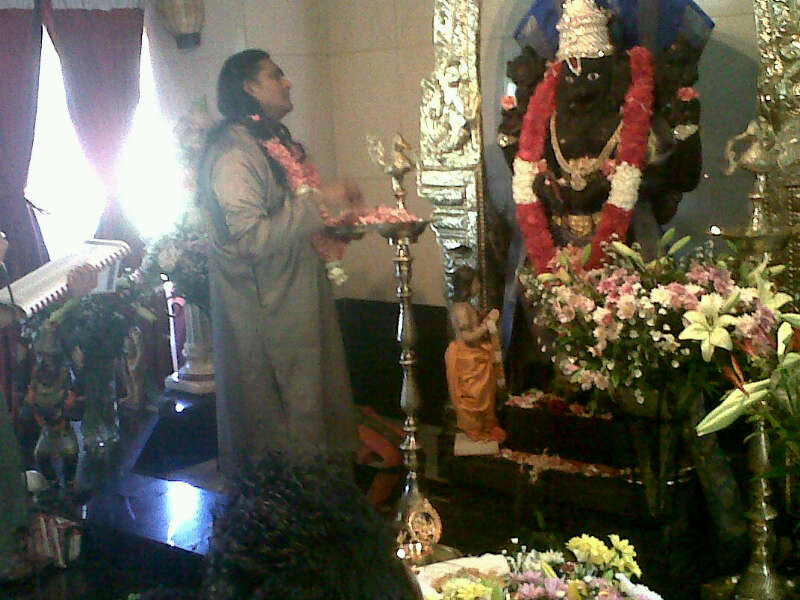
Why is Lord Hanuman’s body covered in Sindoor?


In most Hanuman temples the murthis of Hanumanji are covered or coated with orange coloured sindoor. Why is this so?

After the 14 years of exile were over, Lord Rama and Sita went back to Ayodhya. Once, Hanuman noticed Sita applying sindoor to her forehead. Overcome by curiosity, he asked her “Sita Maa, why are you applying sindoor on your forehead?”
“All married ladies do this for ensuring a long life for their husbands,” Sita smiled. Hearing this, Hanuman right away smeared sindoor all over his body! This is how devoted he was to Lord Rama – he wanted to absolutely make sure he had a long, long life.
Sri Rama was pleased with this gesture of Hanuman and gave a blessing to him that anyone who offers Sindoor to Sri Hanuman will have all his hurdles removed and will be blessed with a long and happy life.

Ram Navami with Swami Vishwananda April 20th, 2013


At Ram Navami, Guruji gave us an extensive and quite informative speech about the incarnation of Lord Rama and of course He knows how to apply Rama`s example to our all lives. Here is the summary:

Rama was the embodiment of Dharma, He was very righteous. The question arises why He did not accept His wife Sita back after She was kidnapped by the demon king Ravana. At that time, a woman was not allowed to be alone in a room with a man other than her father. Otherwise she was not even allowed to enter her house again. So when Rama came back home after many years of exile, people accused Him for taking Sita back. He had to act according to His role as a king in order to appease His people.
What the people did not know was that it was only a shadow of Sita Devi who was captured by Ravana. The real Sita has been guarded by Agni Dev.
There is a close connection between Rama and Agni Dev. Dasharath, Rama's father, was not able to have children. One day Narad Muni, the Divine messenger, came to Dasharath to tell him that the Lord had decided to incarnate into his Yadhava dynasty. He told him to do a yagna in order to conceive a child. During this yagna, Agni Dev appeared and gave two mangoes to him. They were meant for two wives of Dasharata so that they might conceive. One mango was for the incarnation of Narayana and the other one for the incarnation of Adishesh, the serpent. But he had three wives. So the two wives shared the two mangos among one another and this is how it came that two wives conceived one child and the third conceived two children as she got a share of each of the two mangoes.
So Narayana incarnated as Rama, Adishesh became Lakshmana, then there was the shanka and the chakra incarnating as Shatrughna and Bharat.
The reason why the Lord had to incarnate at that time was the presence of Ravana on earth. Ravana was one of the two gate keepers of Vaikuntha; Jaya and Vijaya, who had to incarnate as demons. But this is another beautiful story.

Guruji told us, that whenever the Lord has the intention to incarnate, He asks all the Devas for their assistance on earth, so all come with Him to earth. When the Lord incarnates, they are already all waiting for Him. And all know their mission. This is what we celebrate with Ram Navami.

The reason why Rama refused to take Sita back was because of His people. Sita always stayed pure, She is Maha Lakshmi, but the people did not know this. They were unhappy that their King took Her back after She was with Ravana, as they thought. So Rama had to act on His dharma as a king. 

Relating to this Guruji, was also explaining why the Lord, Narayana, is wearing a tilak, as the tilak symbolizes the lotus feet of the Lord. The meaning of Narayana wearing a tilak is to always remind Himself of the love of the bhakta.

Guruji told us, that the same way Rama was doing His dharma, each one of us should do their dharma. It is not in our hands to decide about this, life will guide us towards this. There is of course the universal dharma of realising oneself, but God has also give us our individual dharma and we have to learn to love it, no matter what our task is. And if we learn to accept it, and realise that the Divine has given it to us, it will lead us to our aim. And this is what it means to live spiritually. How can we live a spiritual way if we cannot accept what God has given us? When we finish our dharma which God has given us in the outside, He will reveal the inner dharma to us. But how will we handle the inner dharma, when we do not learn to handle the outer dharma?

Swamiji says “That is the Dharma. That is what Rama stands for, that is what He is showing. Each one has their own dharma, each one is very important in that. The role of a priest is a priest, the role of a banker is a banker. You can't put the priest into a bank, you know, somebody searching for God, you put him in a bank I am sure the bank will be ruined completely and together with him all the people. If you realise that where God has put you, that is what your dharma is, try to enjoy it even if you don't agree with it.”

20 Apr 2013

Satsang with Sri Swami Vishwananda, 18 April 2013


On Thursday night, Guruji gave another wonderful Satsang, which lasted more than 3 hours. As always, the atmosphere was very joyful with a lot of laughter and Guruji enjoyed his exchanges with the devotees present, often re-directing questions to the audience. And truly there were many, many questions asked. Here is a selection of some of the questions and the respective answers in their essence for you.  In some cases, Guruji gave us new insights and in some he simply reiterated what he has already been saying in past Satsangs:

Q.: Do we have to ask God for help for a sick person only once or several times?
SV: If you have trust and faith one time is enough. If you don´t, you ask many times. To build up faith you should ask only one time and try to trust in Him. If you do things with confidence and faith it will turn out good.

Q.: What is the purpose of life?
SV: Looked at from the mind level, it’s a different purpose for each individual, looked at from the soul level it’s the same purpose for all. You have to transcend the human into the Divine, but not just knowingly – you have to MAKE it happen.

Q.: What is the soul-partner? How to recognise?
SV: The (idea of) a soul-partner is just to make people feel happy about their decision. There is no soul-partner. The real partner for the soul is God. What one perceives as soul-partner is a soul-recognition from past lives. You have to finish things (karma) with them.

Q.: How to transfer spirituality to children?
SV: Be a good example. Never force children. You can talk to them and explain.

16 Apr 2013

Swami Vishwananda - about Surrender


"Only when you really sincerely dedicate yourself and surrender to your path, surrender to what you really want, you will achieve your aim."
Sri Swami Vishwananda

14 Apr 2013

Hari Nam with Swami Vishwananda in Johannesburg

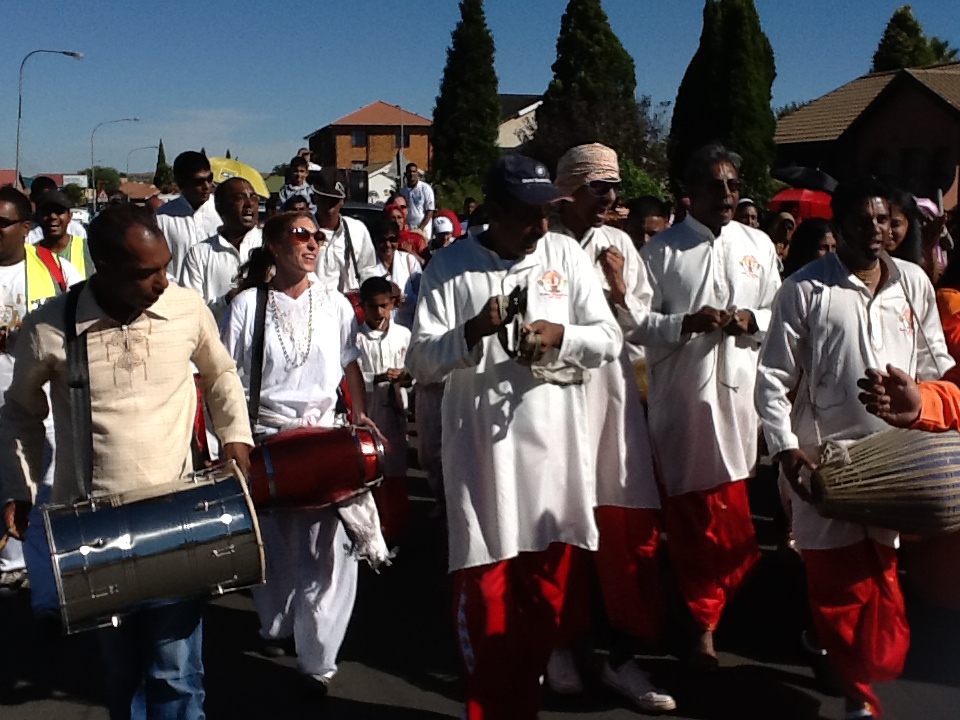
Last Saturday, Swami Vishwananda had the spontaneous idea to organise a procession from Temple to Temple in Johannesburg, which is called 'Hari Nam' - singing the Divine Names of Hari (Narayana/Vishnu).


Over a distance of about 6 km the cheerful group visited 5 Hindu Temples. It was great fun! About 100 devotees and also some of the neighbouring people joined the procession.


 As you can see: a lot of Mridangas (drums), huge kartals (cymbals), and Swamiji with a microphone.
Hari Boooooool! :)


8 Apr 2013

Cook - Seva Scholarship


Special Opportunity
Seva Scholarship as a cook for minimum 3 months


If you have the following knowledge and skills you have the chance to live and do full-time seva at Sri Swami Vishwananda's center Shree Peetha Nilaya in Germany. 
Length: minimum 3 months with possible prolongation
40 hours per week

Food and lodging in the center free.
Living and working in the home of  Sri Swami Vishwananda and the Divine Mother. Participation in daily prayers and most of the spiritual events. Being part of a spiritual community in the culture of Bhakti Marga.

Job: Cook

Description: 
Preparation of the scheduled vegetarian meals as set in conjunction with the head of kitchen.  On a daily basis we cook for a minimum of 60 people and during peak events up to 500 guests.  Cleaning is an integral part of this position!  Be aware that this position requires the ability to stand and work long hours, often overtime.  This is a physical job with the main emphasis  serving our guests.

Requirements:  
  • Responsible and reliable, fulfills all commitments.
  • Knowledge of vegetarian cooking.
  • An interest and excitement about food and cooking.
  • Enthusiasm to learn and try new things.
  • Competent, with the ability for self-management.
  • Able to lead helpers in carrying out ktichen tasks.
  • Able to multi-task.
  • Cleanliness is an absolute.
  • Willing to take direction from superiors.
  • Serving attitude.
  • Working long hours.
  • Overtime during events is the norm.
  • Overall physical health is necessary.


Please apply with an up-to-date photo, your full name, spiritual name, birth date, address, your education and work experience and name exactly which of the above required knowledge and skills you can cover.

Please send your application to Human Resources: tusti@bhaktimarga.org

We are looking forward to your application.

Swami Vishwananda - Some thoughts about the Guru

As you maybe know, Swamiji is in South Africa at the moment, where He gave a Satsang and Darshan.


Here some pictures and a text which Swami VishwaPharanthapaAnanda sent:


"Jai Gurudev! As you all know our beloved Guru Sri Swami Vishwananda is in South Africa at the moment. I have been so inspired in these past few days. I thought that I would share that with all of you:

It is said that the very body of a Sat Guru is the image of every way to freedom and that all things pertaining to life here can be obtained first by knowing what is wished for, and then leaving at the feet of the Master or just surrendering, either way works.
So I thought of this in relation to the physical body of  Guruji and the threefold path of Sanathan Dharma Kama Aatha and Moksha.
  • The feet of the Guru is the Chintamani, the Gem that grants wishes (activated by sincere surrender and obedience)
  • The chest of the Guru is the seat of all known and unknown wealth 
  • The face of the Guru is the solidification of all the levels of enlightenment, realisation and God-realisation.
His entire form is the language of walking with God!

So this is what I wanted to share with all of you - I hope it can be of some use! Jai Gurudev"


IT - Seva Scholarship


Special Opportunity
Seva Scholarship for 3 months


If you have the following knowledge and skills you have the chance to live and do full-time seva at Sri Swami Vishwananda's center Shree Peetha Nilaya in Germany. 

Length: minimum 3 months
40 hours per week

  • Food and lodging in the center free
  • Living and working in the home of  Sri Swami Vishwananda and the Divine Mother. 
  • Participation in daily prayers and most of the spiritual events. Being part of a spiritual community in the culture of Bhakti Marga.

Basic administrative knowledge in one of the following fields:
-  Windows

- Linux / UNIX
- Apple MacOS
- Database (MySQL), Webserver (Apache)
- Networktechnology (primary TCP/IP)


Welcome are also basic skills in programming and webdesign in
- PHP

- HTML
- Drupal (CMS)
- Javascript


It is a must that you are willing to learn new technologies on your own. You have to work with internet research and manuals in order to get the needed information to master the new technology.

Please apply with an up-to-date photo, your full name, spiritual name, birth date, address, your education and work experience and name exactly which of the above required knowledge and skills you can cover.

Please send your application to: tusti@bhaktimarga.org

We are looking forward to your application.

5 Apr 2013

Easter talk by Swami Vishwananda on March 26th, 2013 - part 2

Guruji´s Easter Sermon, Tuesday 26 March 2013 (second part)


"... That's why He said “Be ready.” And how do you train yourself to be ready? It will happen whenever you don't expect it. The Divine doesn't manifest when you expect. This is a little secret. When you don't expect Him, then He will come. But then, if you are not ready, to receive Him, ups, you know, it's gone. The time is gone, it's passed by. It's like life, it is said that when you are born on earth, it's like you're entering a corridor with thousands of doors. And within that thousands of doors, there's only one door, which is open. Which one it is, so what you have to do? You can't stand there and sit and wait. No, time is running. Time is passing by. But you have to make the effort. How would you make the effort is, running fast and pushing each door not just pushing the door, stand there and say: “Oh, door is open, ah, it's locked, I'll go to the next one.” Laziness like this will not lead you anywhere. But when you give your full effort, then you will be rewarded..." 

Sri Swami Vishwananda

3 Apr 2013

First talk given by Swami Vishwananda, Easter 2013


Guruji´s Easter Sermon, Tuesday 26 March 2013


(after Reading of the Gospel Matthew 25, 1-13 and 26, 1-13)

"...This Gospel, it's very very mystical, actually. The mystery of it is related to the lady, the woman, who came and poured the oil on Jesus hair and feet. So this Gospel, the same thing Krishna also said. Which means, you don't know what time, where and how God shall come to you. This is unknown to the mind of men. That's why It is calling everyone to be ready. To be ready at any time. Because you see, very often, people will think that okay, God will manifest Itself, bing, in a beam of light and they all say: „Ah yeah, here He is, „I have come to you, alleluia.“ No, He doesn´t come like this. The Divine is humble. He never comes to the people in His full glory. Because if He comes in His full glory, automatically, there will be a big separation. He's not here to create the separation, He has come to uplift humanity. He has come to raise you, towards God, so why would he come in His splendor?..."

25 Mar 2013

Jai Radhe...

Sri Swami Vishwananda is singing "Jai Radhe..." on the last Darshan

22 Mar 2013

A True Disciple...

...is concerned only with the Divine Nature of the Guru. The Guru's actions as man is not the disciple's concern; he is totally oblivious of it. To him, the Guru is Guru even if He acts unconventionally.


Always remember that the nature of a Saint is unfathomable. Judge Him not. Measure not His Divine Nature with the inadequate yardstick of your ignorance. Criticise not your Guru's action which is done on universal vision.

Swami Vishwa Pharanthapa Ananda from Sri Swami Sivananda (Guru Tattva)

21 Mar 2013

Press Release about Kumbh Mela 2013

History made by Westerners at the Kumbha Mela 2013

The Kumbha Mela 2013, the world’s largest human gathering of all times, ended one week ago. Besides new record numbers, also qualitative historic changes occurred that went largely unnoticed. They bring a new dimension to the story and history of the Kumbha Mela: one of religious tolerance and acceptance and about finally putting differences aside. 

For the very first time in the history of the Kumbha Mela 
  1. a western group - known as the Bhakti Marga movement – could bathe with the Naga Babas and Sadhus 
  2. a joint chariot and a bath by both a Shaivite and a Vaishnavite group took place on the major sacred bathing day
  3. the so called “untouchables”, the lowest of the lowest group of society within the Hindu caste system, were allowed to take a bath in the Holy Rivers 
The Kumbha Mela1 which takes place every 12 years in Allahabad, India, ended one week ago. It is an ancient and grand spiritual festival, full of history and tradition. The Kumbha Mela of 2013 happened to also be a Maha Kumbha Mela, as it comes round only once every 144 years (12 times 12), and it is thus considered to be particularly auspicious. As the international press already pointed out, it turned out to be the world's largest human gathering of all times. 
Besides historically high numbers of pilgrims – 120 million in total and over 30 million on the main bathing day - there were also unexpected qualitative historic changes that went largely unnoticed. They merit to be highlighted, as they are significant and bring a new dimension to the story and history of the Kumbha Mela: a message about religious tolerance and acceptance and about putting differences aside. They constitute a very powerful message in a country that historically has shown a lot of religious tolerance towards others.
Specifically:
1. A group of 50 disciples of spiritual master Sri Swami Vishwananda2 – known as the Bhakti Marga movement - became the first outside Westerners in the known history of the Kumbha Mela to bathe with the Naga Babas and Sadhus of the so-called Akharas during Mauni Amavasya3, the main and most auspicious bathing day (snan) on 10th of February 2013 in  Allahabad. Over 30 million devotees and ascetics took the holy dip, probably the largest human gathering on a single day.
The Bhakti Marga group based in Germany, comprised of mostly white westerners, and both men and women. During major bathing dates, the Akharas always have a separate bathing area from the general public. For western non-Akhara initiates, and both white men and women to be bathing with the sadhus, has never been recorded before.  
The nationalities of the international group include Germany, Russia, France, Italy, Switzerland, Poland, UK, Latvia, Denmark, Portugal, Greece, Serbia, USA, Brazil, South Africa, Kenya, Mauritius, Nepal and India
The co-operation and openness of the Niranjani Akhara4 to allow Sri Swami Vishwananda and his Bhakti Marga devotees to bathe with them on Mauni Amavasya represents a historical moment in the history of the Kumbh Mela.

2. Sri Swami Vishwanananda’s Bhakti Marga group is a Vaishnavite group. By background their spiritual lineage is Sri Sampradaya, founded by the 11th Century Saint of Tamil Nadu, Ramunuja Acharya. During Mauni Amavasya, Bhakti Marga joined the chariot procession of the Niranjani Akhara, a Shaivite group. The Niranjani Akhara chariot was lead by Mahamandaleshwara5 Swami Chitprakashanand Giriji Maharaj. A joint chariot and a bath by both a Shaivite and a Vaishnavite group on a major bathing day has never taken place before.  Historically, each of the 13 Akharas is appointed a specific and separate procession and bathing time on major bathing days.
Mahamandaleshwara Swami Chitprakashanand Giriji Maharaj was interviewed by the BBC for a documentary about the Maha Kumbh Mela soon after Mauni Amavasya. When asked why he had allowed Sri Swami Vishwananda and Bhakti Marga to join their procession, his response was “If someone is taking an interest in our culture, it is our duty to help them go forwards. There should not be any difference between the Vaishnavite and Shaivite paramparas (lineage) – we are all going towards the same Paramatma. Although there may be differences in the Kriyas (yoga techniques) and the teachings, the essence in general remains the same. The Vedas say that there is only one truth, but there are different ways to attain that truth. It is by God’s will that this is happening. It has been a proud moment for the Niranjani Akhara that another parampara has been able to join us.”
3. Throughout India’s history, for as long as can be recalled, the so called “untouchables”, the lowest of the lowest group of society within the Hindu caste system lived on the periphery of society. They handled what were seen as unpleasant or polluting jobs and suffered from social segregation and restrictions, in addition to being poor generally. They were not allowed to worship in temples with others, nor draw water from the same wells as others. Persons of other castes would not interact with them. 
For the very first time in the history of the Kumbha Mela the “untouchables”, were allowed to take a bath in the Holy Rivers Ganga, Yamuna and Saraswati.
Sri Swami Vishwananda: “It has never happened before. In India there is a group of people who clean the sewage with their own hands. They are considered very low caste people, within the lowest caste they are the lowest. They have never been allowed to participate in the Kumbha Mela, not even to approach the Ganges, and this year, after thousands and thousands of years, from the beginning of the Kumbha Mela, this is the first time ever, that they were allowed to take the bath in the Ganges. So, as you can see, there are lots of profound changes taking place. Nobody knows why they are happening now. It is a Divine arrangement.” 

On the 15th February 2013, the second most auspicious bathing date of the Kumbha Mela of 2013, on Basant Panchami day, Sri Swami Vishwananda and Bhakti Marga were invited to join the chariot procession and snan with Sri Maha Mandaleshwar Mahant Santosh Das, from a Vaishnavite Akhara.

The BBC (United Kingdom) is producing a 90 minute documentary about the Kumbh Mela of 2013 and Hinduism for prime time 9 pm airing in May. They interviewed Sri Swami Vishwananda and Maha Mandaleshwara Swami Chitprakashanand Giriji Maharaj out in India, about the themes included in this press release, as well as spirituality and Hinduism in general. They are including this press release story in their documentary and will show the associated film footage. They also followed the personal experiences at the Kumbha Mela of two of Sri Swami Vishwananda’s British devotees, Manish Pankhania (Roshan) and David Johnstone, and have also interviewed them on the subjects of yoga and Hinduism.
Sri Swami Vishwananda (third from the right) and his group of disciples marching in the middle of the night towards the designated spot for the historic holy bath on 10 February 2013.       
One of Sri Swami Vishwananda’s western devotees in front of the chariot of the Niranjani Akhara of Mahamandaleshwara Swami Chitprakashanand Giriji Maharaj, in the early morning hours of the historic 10 Februar 2013.

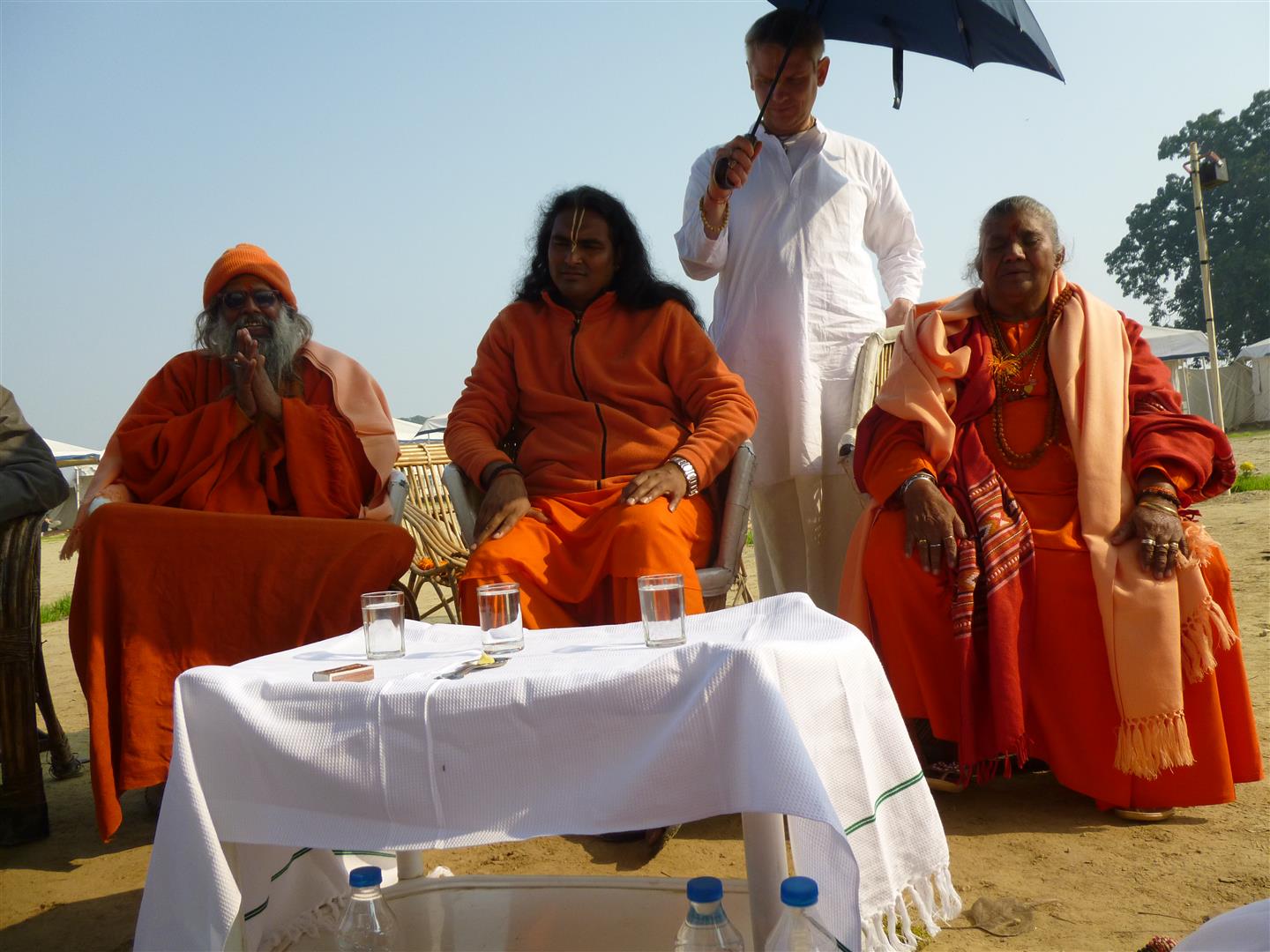
Mahamandaleshwara Swami Chitprakashanand Giriji Maharaj (left) and Sri Swami Vishwananda (middle).  
Sri Swami Vishwananda (second from the left) and Mahamandaleshwara Swami Chitprakashanand Giriji Maharaj (third from the left).   (Image: Bhakti Marga)


Devotees of Sri Swami Vishwananda taking the holy bath. In the upper picture on the left is David Johnstone, whose personal experience is being covered by the BBC documentary which will appear in May 2013.
In the lower image, devotees in jubilation just after taking the holy bath.  
Sri Swami Vishwananda (left) on the chariot of Sri Maha Mandaleshwar Mahant Santosh Das (right) on Basant Panchami day (15th February 2013), the second most auspicious bathing date of the Kumbha Mela of 2013.
        

Devotees of Sri Swami Vishwananda in a jubilant mood on Basant Panchami day (15th February 2013), shortly before taking the Holy bath. 

Sri Swami Vishwananda on the chariot of Sri Maha Mandaleshwar Mahant Santosh Das (in front, western devotees).
A female devotee of Sri Swami Vishwananda making a tilak on a Sadhu during dinner time at the camp of the Niranjani Akhara, at the request of Mahamandaleshwara Swami Chitprakashanand Giriji Maharaj. It is highly unusual in India for a woman to touch a Sadhu, let a alone to paint a tilak on the forehead. Yet another example of going beyond the borders of tradition established over millennia.              
Notes:
1 Sri Swami Vishwananda is a living Master, an embodiment of Bhakti and Love. He originates from Mauritius and resides at Shree Peetha Nilaya, Bhakti Marga International Center, in Germany near Frankfurt.  His movement is called Bhakti Marga.
2 Kumbh Mela is a mass Hindu pilgrimage of faith in which Hindus gather to bathe at the confluence of three holy rivers, the Ganga, the Yamuna and the mythical Saraswati at Allahabad. This event is the world's largest religious gathering, with over a 120 million people attending the event in 2013. The Kumbh Mela is held every third year at one of the four locations - Haridwar, Allahabad, Nasik and Ujjain. 
3 Mauni Amavasya is a special new moon day which this year happened on the 10th February 2013. This day there was the largest human gathering on a single day. It is estimated that over 30 million devotees and ascetics took a holy dip on the occasion of Mauni Amavasya.
4 Niranjani Akhara is one of the 13 Akharas in India. The Akharas are the different sects of Sadhus that have bathing privileges during the most important bathing days at the Kumbh Mela.
5 Mahamandaleshwar is a title used by some Hindu monks of the Dashanami order of Swamis founded by Adi Shankaracharya 1200 years ago. A person called a Mahamandaleshwar has been elevated to the highest level of traditional, Hindu spiritual guardianship. Today India has 80 Mahamandaleshwars.

Devotees of Sri Swami Vishwananda handing out food to Sadhus at the camp of the Niranjani Akhara.         
Contact:
To learn more about Sri Swami Vishwananda and Bhakti Marga and to request film and photographic footage of the historical moments of the Kumbha Mela 2013, please contact:
Swami Kuru, Bhakti Marga Media Relations
Address: SHREE PEETHA NILAYA Bhakti Marga Centre Springen                           
Am Geisberg 1-8, 
65321 Heidenrod – Springen, Germany
Phone number:  +49 178 320 48 01 (mobile)       +49 6124 605 91 01 (landline)