18 Nov 2012

Christmas Programme at Shree Peetha Nilaya


On the 24th December (Christmas Eve) we will start the ceremonies at 17:00 by singing the Akathist to baby Jesus, reading from the Psalms, old testament and Epistels as part of the Royal Hours. We will also sing Christmas songs during this time. There will be a break for evening meal and then we will commence with the liturgy of St Basil from 22:00hrs. During the liturgy of St Basil we will carry out the intercession, Canon of Nativity, Benediction of the loaves, procession with baby Jesus and the gospel will be read in different languages. We expect that the evening ceremony finishes just after midnight. 

On the 25th December (Christmas Day) there will be an abhishekam carried out to baby Jesus at 10:00 whilst we sing songs to baby Jesus. Later in the evening there will be OM healing and a liturgy from 18:00hrs.

Please fill in the registration Form to register for Christmas on the 24th and 25th December 2012 in Shree Peetha Nilaya. This form MUST be filled out once for each person attending the eventAll starred fields must be filled in. Donations are welcome!
To register, please click here:

17 Nov 2012

4th part of the Pilgrimage

East India Pilgrimage with Swami, part 4

Today we got up at 8am and after breakfast, at 9am, we went to the small Devi
temple nearby. There everything was prepared for Chandi Path, a yagna to Durga Devi. All the 40 of us sat near the yagna kund. Swami asked me to do the prayer representing the group as he said he would not come. 


The priest started the puja and instructed me about every step. He had an „apprentice“ assisting him. Just as the fire was started, after all the purification and invocation was done, Swami came and joined in. We recited „Om Aim Hrim Klim Chamundaye Vicche“ 108 times, then followed different Devi prayers and mantras. The whole prayer took about 2 hours. Swami again mentioned how special this temple and the presence of the Devi there is.

After completion, we walked again to Kreem Kund to meet Aghoreswar Sidharta Gautam Ram Jee. When we arrived, we again met with our „friend“ whom we woke up from his peaceful sleep. He told us, that Gautam Ram Jee decided to come later on the 16th November, so it was not possible to meet him. However, he said that when Swami comes back for the next pilgrimage in February, he would be able to meet with him. We stayed some time and chatted with the Aghori, who seemed to have made this corner of the temple (in open air) his home for some time, as he had all his utensils and his „bed“ prepared there. In his humorous and bright way, he told us more about the Aghora path life style. He said, that all what he achieved, all his siddhis, e.g. to be able to „touch the
sun“, to see through the eyes of birds and other beings, to be at 10 places simultaneously, etc., he achieved it through putting all his focus on his Guru, Aghoreshwar Baba Bhagwan Ram (who passed away in 1992). His Guru “gave” him everything. He  said that there is no particular sadhana that Aghoris do, their sadhana is their Guru, and whatever he gives them they will perform.
At some point a “typical” aghori arrived at the temple, dressed in black, with a black turban, big chains around his neck, long beard, and walked quite fast from one place of worship to the other, followed by two other men. Upon seeing this, our friend “laughed” and said, that one cannot distinguish if these “babas” are crooks or genuine. He said the outside “show” is not important for a  true aghori, in fact an aghori might as well be dressed completely normal, more normal than so called spiritual people. All divinity and power is within. He said love especially for ones Guru and also ones Ishta Dev is all what counts. Also the so called “naga babas”, who walk around completely naked, he said that there is practically no genuine naga baba anymore. He said they are mostly beggars asking for money. He told us that these people are coming here (Kreem Kund) today because of Deepawali, the festival of lights, and that in the night they would do their sadhana on the cremation grounds. We asked him, if he also performs his sadhana on the cremation ground tonight. He said, that he will not go tonight, that he doesn't care, he goes whenever he feels like going... Anyway, he said, for
him, the best cremation ground is Kreem Kund, better than all the other ones, cause here is the burial place not of “normal” people, but of the Aghori saints, which (their energy) makes a great difference for improving ones sadhana. He said that Kreem Kund was the very first cremation ground or cemetry of Varanasi. Actually it was Baba Keen Ram, who brought fire from the cremation ground and lit up the dhuni (sacred fire) here. Since then, several hundreds of years ago,
the very same dhuni is still burning, and the only prasad that is given to the devotees is the ash of Baba Keena Ram's dhuni.
It was really nice and very interesting to speak again with this humble and simple man. We bid farewell and walked back to the hotel. On the way we went to a small Kali temple where they had built up a huge (over) life size Kali statue for Divali celebrations:


Back in the hotel we had lunch and the remaining time of the day was “free time”.
As it was Divali or Deepavali, at night there were a lot of fireworks everywhere. The whole city was filled with loud explosions of firecrackers. Already in the afternoon children set up firecrackers in the streets. Some of them simply poured out black powder on the floor and lit it. It didn't feel very safe to walk through the streets with all these “bombs” everywhere. 
At night Swami went on the roof of the hotel and had great fun to light firecrackers with the hotel staff. The noise continued the whole night of course.
The next day it was time to say good bye to Varanasi. We left around noon and with boat, bus & plane we travelled back to Kolkata where we checked in to our hotel at around 9pm. 
Early the next day, some of us went again to Dakshineshwar to see Kali, and afterwards to Kalighat, also to see Kali :) There I also managed to buy a Tara that Swami asked me to get for the Kali temple in Springen. Finally we got back to the hotel, checked out, drove to the airport, and flew back home...
We had a really wonderful time in India, were graced with the presence of many saints, Gods & Godesses, and most uplifting of all, we had 14 days in the presence of our dearest Guru, Sri Swami Vishwananda!!!

Jay Guru Dev!

14 Nov 2012

3rd part of the Pilgrimage


East India with Swami, November 2012, Part 3
After arriving at about 7am in Bhod Gaya, we went straight to the hotel. After a big breakfast all of us fell in bed half dead. We were lucky as the beds were very good and comfortable. The hotel was completely new, so new that they did not yet have internet access (only in the managers office, that's where I sent the last report from) and the third floor was still a construction site. 

At about 2pm we met again and after lunch we left to the town. There we visited the most important Buddhist pilgrim site: The place where the Buddha got enlightenment. There's a large temple and behind it is the giant banyan tree under which Buddha was sitting when he got enlightened. The whole temple complex had a very, very serene atmosphere. There weren't any priests in the temple doing any puja and it was quite different from the Hindu temples, that sometimes resemble market places with greedy priests waiting for money. We sat for about half an hour with Guruji beneath the tree alongside other pilgrims, mainly from Asian countries.

After meditation we did some shopping and finally drove with the bus to our next destination, Vishnu Padam, where there is the foot print of Vishnu. As the bus couldn't enter the narrow streets, we walked the last bit to the temple. The sanctum of the temple is round shaped with a rock on the ground on which there is the foot print of Vishnu. The puja is done in such a way, that the devotees give a donation, put Tulsi leaves and flowers on the rock around the foot print, and the priest then puts a white cloth on the foot (the foot is painted red) on which then appears the foot print of Vishnu. This cloth is  then given back to the devotee who can take it home.


The next morning we left at 10am and took the road to Varanasi The drive was about 5 hours long. 
We again had lunch packets that were served in the bus. Finally we arrived in Varanasi. Before entering into the city one passes a lot of poverty along the roadside some people living only in a shack, others without any roof, lying on the plain floor. Near the Ganges we had to leave the bus and continue on foot and then take a boat. The „old town“ of Varanasi is built along the Ganges and one cannot access it with buses. 
During the boat ride we got a first impression of the holy city of Varanasi, which used to be known as Kashi and also as Benares. The city is dedicated to Lord Shiva and his wife Parvati. Many Hindus come here before dying to be cremated as the atmosphere is very sacred. One can feel the effect of the many saints that have graced this place. 

After about a 20 minutes boat ride we reached „Rana Mahal Ghat“ where our guest house is situated. The „ghats“ are the steps that lead from the city down to the Ganges where the people go to have a dip in the river. We climbed the steep steps from the river towards our guest house. Its name is „Palace on steps“. Although from outside it does not look like a palace anymore, inside it is very nice. Guruji found out, that it was built by the royal family Ranaprakab Singh who were the in-laws of Meerabai Devi, the famous saint. We checked into our rooms. Swami got one of the round „corner rooms“ with a wonderful view on the Ganges. 

Right after check in we went again down to the river and took a short boat ride to the main ghat. There the aarti was performed to Mother Ganga as it is done every evening. There are about 12 priests and each one of them is doing the aarti, while
many devotees gather and sing bhajans or dance for Ma Ganga. After the aarti is finished, all the people that were watching from the boats light a small butter lamp which is placed on a little basket with flowers and offers it to Ganga. It was very beautiful to see all the little lights floating on the river. 
When we got back to shore, we took the ghat before and walked a bit through the narrow streets. There are many shops where one can buy just about anything. Suddenly we turned into some kind short side road. At the end was a big door that read: Sribendu Lahiri. We entered into a beautiful courtyard. Inside there were two mandirs, one was dedicated to Shyamacharan Lahiri (Lahiri Mahasaya), his son Tinkori Lahiri and grandson Satyacharan Lahiri, the other was dedicated to Mahavatar Babaji. 

The temple, which was built by Lahiri's great grandson, contains the ashes of all three of them. It was a wonderful, peaceful atmosphere inside and we sat with Swami for a while in meditation. Then the person who looks after the place showed us the original of the famous photograph of Lahiri Mahasaya. 

When we got back to the hotel, we found out, that the nowadays hotel used to be Lahiri's Ashram, and the room that Swami chose, was the room where Lahiri used to meditate!

At night we had a good meal which we ate on the terrace of the guest house. The restaurant is caged as for the monkeys not to steal the food. The hotel staff showed us also the rooftop which is a great place to meditate, overlooking the Ganges river.
The next morning we started early, at 6am, to make a boat tour along the river. That way everyone who has never been there got a first impression of the city. Besides the merchants that come by boat to try to sell their things (see a DVD and CD sales boat on the picture), we also encountered some Asian pilgrims who liked our bhajan singing that they even started dancing on their boat:

After breakfast we went to the most important temple in Varanasi: Kashi Vishwanath. It is a Shiva temple which contains one of the 12 Jyotir Lingams of India. We had to go inside in groups of 10 persons. First we needed to register our passports as they are very strict not to let any Muslims enter the temple due to tension between Hindu und Muslim community. In the past history the temple had been destroyed and a mosque was built instead. Now the temple is just next to the mosque. It has a roof which is gold plated with 900kg of real Gold which was donated by a Maharaja some time back. There is quite a lot of police and military presence around the temple. Europeans are normally not allowed, only in exceptional cases if they follow the Hindu tradition. We were allowed however. 

We had a short Darshan of the Lingam as there were many people trying to push through. But it was definitely very nice to see and feel this special place. Photography was strictly prohibited. After Vishwanath we strolled through Varanasi and visited a few other temples. One of them was the ashram of Shri Satuwa Baba where we were received very warmly and got a cup of tea from the
Brahmacharis there. The afternoon was free for everyone (first free time on this trip) and most people used it for some shopping. Some people went also to the aarti in the evening. 

The next morning we started at 10am. First we visited a small ashram nearby. Unfortunately I dont remember the name of the saint who founded the ashram, but he is a quite famous Vaishnava Saint. One of the Brahmacharis showed us around. We sang some bhajans in their temple and the Swami was gifted with a personal shawl of this saint. They said that he was the first one to propagate the Mahamantra “Hare Krishna Hare Krishna, Krishna Krishna Hare Hare, Hare Ram Hare Ram, Ram Ram Hare Hare” in our times, even before Srila Prabhupad.
Next on the program was the “Kashi Dham, Shakha ashram” of another local saint, and then we went to a small temple which was the house where Ramakrishna stayed in when he visited Varanasi. He lived in that room for three months and performed regular Puja on a Saligram there. The granddaughter of the man who hosted Ramakrishna back then welcomed us warmly and showed us the padukas that Ramakrishna was wearing while being at that place. 


After leaving that place, we went to Krim Kund. It is the place where Aghorachara Baba Kina Ram practiced his Aghora Sadhana and introduced the Kinarami Aghor tradition. Baba Kina Ram received his instruction directly from a manifestation of the great Dattatreya (a manifestation of Brahma, Vishnu and Shiva together). Baba Kinaram (1563-1714) revived the Aghora tradition which existed already before. It said to go back to Shiva himself and having been propagated by Dattatreya. One of the meanings of Aghora is: A & Ghora: Ghora = Difficulty, A = “not”, therefore it is said to be the path which is not difficult, but easy, a simplified worship. Aghoris do not believe in any “formalities”.

At the Krim Kund Guruji and some of us had a very nice and fun chat with an Aghori for almost an hour. He explained us a lot about their tradition. He said that a true Aghori does neither need to smear himself with ashes and pretend to be crazy, nor does he need to display his spirituality as a “show” in any other way, but just be simple and “normal” towards the outside, while of course the inside burns with love for the Divine. He said that they (the temple) did not accept any donations from government or foreigners in order to remain independent. I told him that my donation of Rs50 was accepted at the temple, upon which he laughed and said that he could even give me a donation of Rs1000, and I said I could give him Rs1500 back... He said that he has the “power” to generate whatever he needs for himself and doesn't need anyone to look after him, but that nature looks after him. The only one they really believe in is the Guru. Even the Gods are secondary, cause they can only be attained through the grace of the Guru. This reminded us again of the utmost importance of the sadguru. It also reminded me of Vijaya Krishna Goswami (a Vaishnava Saint of Bengal) who said about Ramakrishna, that because of his accessibility, people do not recognize his greatness and importance. If he were to live in the Himalayas, people would appreciate him more. And again, I thought of our Guru, and how he is only waiting that we sincerely long and pine for God, not wanting anything else, so that he can pour his grace in us.
The founder, Baba Kinaram, said when he was alive, that his 11th successor will be his reincarnation. We found out, that the current head (Aghoracharya) Sidharta Gautam Ram Jee, is in fact the 11th head of the Aghors after Baba Kinaram, and therefore considered the reincarnation of the great saint Baba Kinaram, and we were able to arrange a meeting with him for tomorrow Tuesday.


After this refreshing and fun conversation, we walked further about 5 minutes and reached the ashram of Anananda Moy Ma. The mandir was closed so we just sat there some time in meditation. 
Later on we took a boat to another ghat. There we visited Trailanga Swami Math. Trailanga Swami (or Telang Swami) is probably the most famous saint of Varanasi. He became about 280 years old, others say that he was over 300 years. He always walked around naked, innocent like a child, not caring about the outside. Ramakrishna called him the “walking Shiva of Varanasi”. To sit in his math, where he used to worship, was very, very beautiful. There is a huge Shiva lingam which is said that Telang Swami carried himself from the river to the temple, a task only possible for someone who can defy gravity. Only by touching it one could feel its power and sacredness. Telang Swami also installed a HariHara, a murthi of half Krishna, half Shiva, of which there are only two in whole of India. Besides this murthi, he installed also an image of Kali. Before he took mahasamadi, he asked his disciples to build a big (he was very large) wooden coffin for him. When he died, they put him in there. Upon opening the coffin a few days later, instead of a dead body, they found it full of fragrant flowers. Some people, up until today, have said that they have seen him on the shore of the Ganges...

After leaving Trailanga Swami's muth, we took again the boat and came just in time to again participate in the Aarti. Swami got a special seat just next to the singer. 
I am not sure if there will be more reports, as on the 14th we will already be flying back to Kolkota, and from there to Europe. 

12 Nov 2012

Dhanteras Livestream


Jai Guru Dev Friends and Family!

We will livestream the festivities of Dhanteras (11 & 12 Nov) Diwali (13 Nov) 2012. After a wonderful magical evening last night, where it felt as if our Guruji Sri Swami Vishwananda beamed his body from India to Springen, so uplifted was the atmosphere, we felt we should livestream the prayers to Shree Mahalakshmi* & Sri Kubera so you can partake in them if you want.

So tonight and tomorrow evening at 18:00 we will livestream the pujas out of the temple at Shree Peetha Nilaya.


Sorry for the short-term notice. We hope you can join in nonetheless.
Much Love
Your Shree Peetha Nilaya / Bhakti Marga Team 
 
Shree Dhana Karshana Shree Mahalakshmi Sahita Sri Kuberaya is the full name of Mahalakshmi/Divine Mother, whose name our Ashram Shree Peetha Nilaya carries, and whose home the Ashram is 
 

11 Nov 2012

Second part of the Pilgrimage

East India with Swami, November 2012, Part 2

This morning we should have left as early as 7.30am, but due to „Indian“ circumstances we left at around 8.15am, after all the luggage was loaded in the bus. Our first stop was at a Jagannath temple outside of Kolkata. The sister of one of the waiters at the hotel gave us this „address“. When we arrived, we were warmly greeted and led into the temple. The cousin of the waiter who was there explained us the history of the temple. It was not so easy to understand what he was saying, we all understood only bits and pieces, which I try to recreate here: The temple is based on a dream-vision of Ramakrishna, however, the temple was built by another saint who miraculously „received“ the wood stem from which the Jagannath murthi was carved from the river. Ramakrishna later also visited this temple. Just like in the “real” Jagannath temple which is situated in South East India, in Puri, also here Lord Jagannath is carried once a year in a procession to his “cousin” in a temple nearby where he stays for about one month before being brought back again. 
We hit the road again and drove to Tarakeshwar to see one of the 12 Jyotir Lingams. The journey took us longer than expected, and we had “mixed” information as whether Non-Indians are allowed to enter the temple or not. The bus had to be parked quite far from the temple and we had to walk for about 15 minutes, crossing the Tarakeshwar train station, to reach the temple. On they way there, Swami found it quite funny that nobody could tell us whether we'd be allowed in there or not. One person whom we “picked up” on the way became our guide. After buying some prasad and flowers to offer there, we were finally led into the temple. The priests were friendly and let us enter the temple without any problems. Guruji took the prasad and went into the sanctum itself with a priest to offer the food and flowers while everyone else waited outside a few meters in front of the sanctum. The lingam itself was covered with a cloth and nicely decorated. Finally we walked back the long way to the bus, having some fresh bananas on the way. 
Back in the bus, our “Swami Sri Yukteswar” adventure began... The whole day and the day before already, Yamuna and our guide spent on the phone, trying to locate the house where Swami Sri Yukteswar lived. With every phone call, we got a little “closer” to our goal. Finally we reached and got out of the bus. We had to walk about 5 minutes through the town of Serampore which seemed to still look the same way as it did when Yogananda and Yukteswar walked these streets. The buildings are very old, built during the colonial times by the British. Finally we reached the house where Yogananda lived as a boy. It is being nicely kept by the Yogoda Satsanga Society that Yogananda had founded. We sat a few minutes in his room to meditate. 

Then we walked onwards to the residence of Swami Sri Yukteswar which was a few minutes away. However, we couldn't get into the house where he actually lived as it was locked. We found out that this is house had new owners and the apartments in it were rented out. The man working there told us, that nobody was home. Beside it stood a small temple in memory of Sri Yukteswar that we visited instead. Not quite satisfied, on Swami's instruction, Reena and I went to the house again to speak with the man who told us the same thing again. Despite of what he said, Reena knocked at the door, when suddenly an old lady came and opened the door for us. We called Swami and the rest and we were all able to enter into this historical house. We stepped up the stairs just like Yogananda and his secretary Richard Wright once stepped up to be received by Swami Yukteswar when he was still alive. We walked along the balcony and came to the room of Yukteswar. It was locked but we were able to peek through the window. We lit it up with our torches and could see a simple altar and some boxes and suitcases. Otherwise the room was empty. After everyone had had a look inside. Standing on the balcony, Swami pointed out the place down in the courtyard where the Guru used to meet with his disciples to give satsang and teach them in the discipline of Kriya Yoga and Spirituality.
Yogananda attributed Yukteswar's small number of disciples to his strict training methods, which Yogananda said “cannot be described as other than drastic”...
We left the house again and went for lunch (it was already 5pm, so it was dinner rather). Before I could eat anything, Swami asked me to accompany Reena once more in order to find out the telephone number of the owner of Yukteswar's room, so we went there again, accompanied by Swami's driver (Swami is sometimes driving in a separate car during the pilgrimage). Again we, or rather our driver, talked to the man near the house. Finally, he instructed another man to lead us to someone else, who apparently knew more. A few houses later we arrived. That other man called into the house the name of another man... After waiting two minutes, he came out. The first thing I remarked was his nose which somehow reminded me of Swami Sri Yukteswar and I thought for a second that he looks like a relative. As we were talking, he told us, that Swami Sri Yukteswar was his great grandfather! Of course we were happily surprised to hear that... But not only that, he told us, that he knew that we were coming and that it was Yukteswar's grace that we found here. He said we should come back with our whole group to show us some of his great grandfather's personal items... This we did, and one by one, we could receive the blessing/darshan of Yukteswar's pujaconch, Gita bookholder, pot, plate and his ink & pen holder. He explained to us that the room in the
original house is locked due to some unresolved family matters. We thanked him for his kindness and hospitality, but he just pointed to Yukteswar and said that it was all his will. 

After this nice experience we again took the bus to drive to Halisahar, the birth place of Sri Ramprasad Sen, the “bard of Kali”, who wrote many poems and songs to his beloved Mother Kali and Tara. Unfortunately we couldn't make it as lack of time & very bad roads on the way didn't allow us, so we headed straight for our Hotel in Krishnasagar However, Swami managed to visit the temple of another Vaishnava woman saint. At the hotel we got a very good, late meal and then finally to bed.

This morning we all left “on time” at 7am! The bus ride was only 30 minutes and we arrived in Mayapur, birthplace of Chaitanya Mahaprabhu. And that was the first temple we visited, Chaitanya's birthplace. He was born under a Neem Tree which is also the center of that temple there. There we met with Swami Govinda, a former student of Sathyanarayanaya Das. He was very kind in showing us around in all of Mayapur and Nawadwip. 
After Chaitanya's we went to the main ISKCON temple in Mayapur. It was very impressive to see the huge size of the whole temple complex. At the moment they are building a new temple, the biggest one ever, which will contain a planetarium and a huge dome. The current main temple with a huge Radha Krishna, Narasimha and Gaur Nitay was very nice to see and spend time in. We also visited the Pushpa Samadhi of ISKCON Founder Srila Prabhupada (see picture). His main Samadhi is in Vrindavan and in Mayapur are only flowers that were put on his body and then brought there. Yet the Pushpam Samadhi is huge and the statue of Prabhupad apparently made of real gold. 
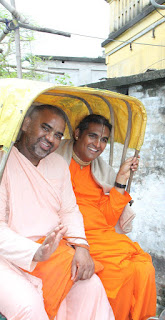
We then walked for about 20 minutes through dirt and mud until we reached the “port” at the Ganges river. There we took a ferry boat that brought us within about 10 minutes to Nawadwip. There we took Bicycle Rikshaws, always two people together, and drove to the samadhi of Srila Jagannath Das Babaji Maharaj. It was good fun to drive through the narrow streets of the town. 

In the temple, Swami told us that Babaji Maharaj was a Siddha (perfected being) who attained everything by chanting the divine names. When he was already very old, his disciple servant carried him in a basket on his head from Vrindavan to Nawadwip. As a siddha he was able to make himself very light so that his disciple had no troubles to carry him. Although on the way he sometimes teased his disciple by making himself heavier. Short before his mahasamadhi he called this disciple and asked him, if he wanted to attain Gaur Nitay, or if he wanted to be rich. His disciple, who never had any money in his whole life, asked his Guru, if it was really possible for him to give him money, as his Guru never had any money either. Jagannath Das Babaji assured him, that he could make as much money for him as he desired. His disciple said he wanted to see that. So at the next morning, the Guru asked him to go down to the river to a certain place. He went there, and as instructed, he opened the cave there, and saw that it was filled with gold, gems and other valuables. Shocked, he ran back to his Guru, fell at his feet, and declared that he wanted nothing but to attain Gaur Nitay. Immediately his Guru made him attain them and they appeared in front of him. Srila Jagannath Das Babaji took mahasamadhi at the age of 157 years.
We again took the rikshaws and went to another temple, the house where Chaitanya's wife Vishnupriya lived. They told us, that when Chaitanya decided to take sannyas, his wife asked her husband, what she was going to do now, as he was her everything. He gave her his padukas and told her to worship them, and that he would always be with her. She did as he told her. Her devotion was so strong, that she finally merged into the sandals. All that was left of her was her nose ring which is now adorning her murthi. After telling us the story the priest there blessed us with Chaitanya's padukas which are still kept in this temple. The energy there was very sweet, with a very devotional atmosphere. 

We then went back to the boat which drove us back to Maypur. Back in the bus we all
got a wonderful meal. Everyone got rice, mixed vegetables, potatoes, chapati, pickles, salad and a small dessert. The road that we had to take reminded me of the moon landing and how to astronauts drove through the craters with their moon vehicle. We did not have a moon vehicle, but we definitely had a lot of craters to drive through! Even Yamunashree, who traveled already a lot in India and Nepal, had to admit, that she had never experienced such a bad road before. We reached our destination, Tarapith, at around 10.15pm. Unfortunately the temple was only open until 10.30pm, so we had to go for dinner and take our rooms and had to wait to see Ma Tara until the net day. Some found out that the first abishek on Ma would start at 4.30am the next day, so I set my alarm clock for that time.
However, for some reason my phone automatically changed its time zone (it had finally realized that it was in India) and I missed the prayers... : (Few others however were luckier and made it there in time. They made contact with a priest who would then arrange the Darshan of Ma for our group. We had breakfast in the hotel and then went to the temple. After buying the prasad we were led into the temple. Swami and I bought two idols of Tara Ma to be blessed on the murthi of Tara in the temple. Once inside the temple, we saw the most beautiful silver image of Ma Tara... We received her Darshan, blessing and also the blessing of Her padukas. We also were able to put our statues on the padukas and the murthi itself, getting them blessed. After the Darshan we could sit in the temple complex for mediation for about 15 minutes. Within the temple complex are several shrines, also one for Mahavishnu, Garuda and Bhama Kepa (Bhamdev), the local saint. All the prayers that are offered to Ma Tara are finally offered to Maha Vishnu. Afterwards we visited the local smashan (cemetery) where the Aghori Babas do their sadhana. Tara once promised to Bhama Kepa, that whoever does sadhana at this place would attain siddhi.
After that we did some shopping, and then some of us took a motor rikshaw to a village about 2km from there to where Bhama Kepa was born. We were received warmly by the great grandson of Bhama Kepa's brother. He showed us where Bhama Kepa was born and lived for the first 20 years of his life. When he was still a child, he was sick and his parents brought him to Tarapith in their desperation. Tara appeared to his mother and told her, that her son would be well, but that in due time he would be hers. She agreed and her son got well. Once he was in bhava, and he imagined himself to be helping Hanuman setting fire to Lanka and set fire to the rice paddies of the village. Another time he took all the village deities to the river and declared that they told him that they were thirsty. When Bhama Kepa was about 20 years old, his mother had to fulfill her promise and let her son go with his assurance, that he would come whenever she called for him. He became the disciple of a Tantrik Guru who arrived at the village and performed sadhana at the local cemetery. All the people from the village were afraid of him, only Bhama Kepa wasn't cause he felt that this man could help him attain his beloved Tara. The Guru recognized Bhama Kepa and accepted him as his disciple as he knew that Tara had sent him there to teach him. Bhama Kepa mastered all what his Guru taught him and became himself a siddha. He spent most of his life at Tarapith. 
Once he visited Dakshineshwar and met Ramakrishna. He said that he liked Kali there very much and asked Ramakrishna to give him the murthi of Kali so he could bring her to Tarapith as Kali looked like the sister of Tara. Ramakrishna touched his eyes and in that moment Bhamdev could see that they were one and the same, his Tara and Ramakrishna's Kali... On another occasion a person with a severe stomach illness came for healing. Bhamdev kicked the person in the stomach several times and shouted “go away”. In reality, he shouted at the illness to go away, and the person got completely cured after that. Bhama Kepa lived for about 80 years.

(Bhama Kepa's brother's grandson & his wife who look after the temple)
JAY MA TARA!!!

After packing our luggage we left Tarapith and stopped about 20 minutes later to look at
Nityananda's birthplace. Unfortunately the temple was closed, but we were able to see his birth house. On the way back to the bus we were attacked by some angry cows and Jyaanaprakash nearly lost our expensive camera to an unhappy cow. Finally, at 3pm, we could start our 400km journey to Gaya, which would take us 12 hours of bus ride, out of which were 3 hours again on dirt roads with gigantic holes... Finally we reached Bhod Gaya early in the morning, had a breakfast and could catch some sleep.
 JAY GURU DEV!!! JAY TARAAAA!!!

(a big "Thank You" to Paartha for this wonderful report!!!)